
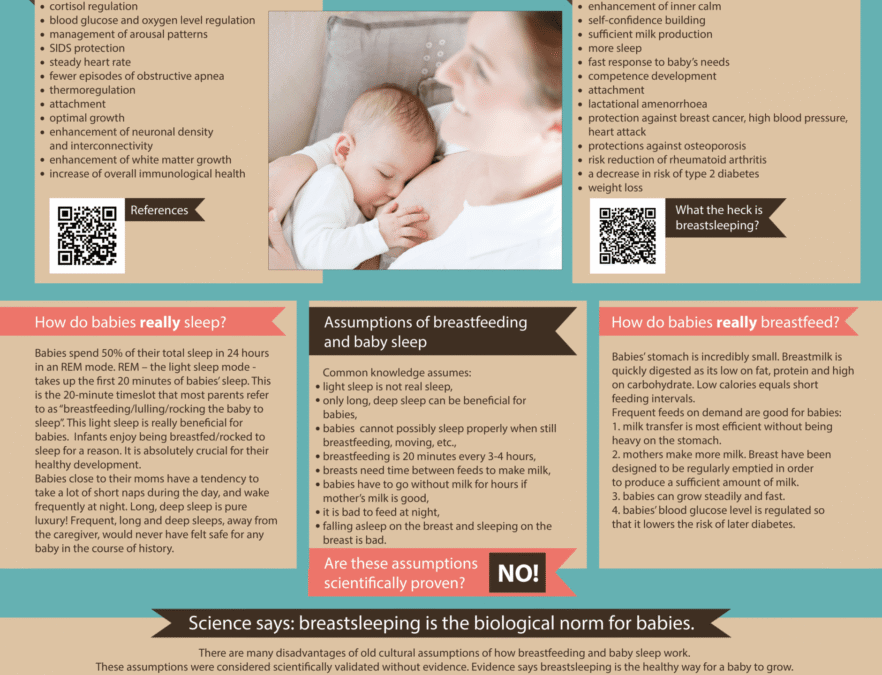
Your baby finally falls asleep at the breast. Their body becomes heavier, their hands relax and you wait – just to be sure. Then you carefully try to put them down.
Their eyes open almost immediately.
Or perhaps your baby sleeps peacefully beside you but wakes again and again in their cot. They may take short naps, ask to breastfeed more often than you expected, or seem to notice the moment you move away.
It is easy to look at all this and wonder: Why can’t my baby just sleep? But perhaps your baby is not sleeping badly at all. Perhaps they are sleeping like a baby.
Breastfeeding and sleep belong together
We often talk about feeding and sleeping as though they were two separate parts of a baby’s day. The baby feeds. Then the feed ends. Then the baby is supposed to be put down and sleep.
Real life with a breastfed baby rarely looks so tidy.
A baby may drift in and out of sleep while feeding. They may pause, suck again, stretch, sigh and settle more deeply. Sometimes they wake when the breast slips from their mouth. Sometimes they feed without either of you fully waking.
You may not even be sure where breastfeeding ends and sleep begins. This close relationship between breastfeeding and infant sleep is what Professor James J. McKenna and Lee Gettler called breastsleeping.
The word brings together two things babies never separated in the first place.
Your baby’s sleep may not look the way you expected
Before we have a baby, many of us imagine sleep as a long, quiet stretch in a cot. Babies, especially young babies, tend to sleep differently. Their sleep is lighter, their sleep cycles are shorter, and they move between sleep and waking more easily than adults do.
They may:
- fall asleep while feeding;
- wake when you try to put them down;
- sleep longer in contact with you;
- take several short naps instead of one long one;
- make noises, wriggle or suck in their sleep;
- breastfeed frequently during the night;
- wake after one sleep cycle and need help settling again.
None of this automatically means that you have created a bad habit or taught your baby to sleep incorrectly. It means that your baby’s sleep is still developing.
Why does my baby sleep better close to me?
Your baby does not experience your body as an optional extra. Your warmth, smell, breathing, voice and movement are all familiar. They tell your baby that you are still there. Sucking also helps many babies settle and move into sleep. So when your baby wakes as you lower them into the cot, they are not being difficult. From their point of view, something important has changed.
One moment they were warm, held and close to the breast. The next moment they are lying still on a different surface without your body around them. Of course they notice. Understanding this may not immediately give you the uninterrupted night you desperately need. But it can take away the painful thought that your baby is manipulating you, refusing to sleep or that you have somehow caused the problem.
You have not ruined your baby’s sleep by helping them fall asleep.
Why do breastfed babies feed so often?
Breastmilk is digested easily, and young babies have small stomachs. Frequent feeding supports milk intake and milk production, particularly during the early weeks. But breastfeeding is not only about calories. Babies may also come to the breast because they are thirsty, tired, unsettled, overstimulated, uncomfortable or simply in need of closeness. Sometimes they take a full feed. Sometimes they suck briefly and drift back to sleep.
This does not make the breast a “bad sleep association”. It means your baby is using one of the most powerful ways they have to regulate and settle. If frequent feeding is painful, your baby is not gaining as expected, or you are worried about milk transfer, it is important to seek skilled breastfeeding and medical support. Frequent feeding can be normal, but you do not have to ignore a problem or struggle alone.
Does breastsleeping mean that I have to share a bed?
Breastsleeping describes the close relationship between breastfeeding, proximity and sleep, particularly when a breastfeeding mother and baby sleep beside one another in the absence of known hazards. But understanding breastsleeping does not mean that you must sleep in one particular way.
Some families share a bed. Some use a sidecar cot or a separate sleep surface close to the parents’ bed. Others want their baby to sleep in a cot and are looking for a gentle way to make that easier.
Your sleep arrangement needs to consider your baby’s age and health, your own circumstances, how your baby is fed, and current safer-sleep guidance. If you bring your baby into bed to feed or comfort them, it is worth learning about safer bedsharing even if you do not intend to fall asleep. Exhausted parents sometimes doze unintentionally, and planning for that possibility is safer than pretending it could never happen.
You can read my separate guide here:
Bedsharing with a baby: making an informed and safer choice
Knowing what is normal does not mean you have to enjoy every minute
There is an important difference between saying that a behaviour is biologically normal and saying that it is easy. Frequent waking may be normal, and you can still be exhausted. Your baby may genuinely need closeness, and you may still long for an hour when nobody is touching you.
Breastfeeding to sleep may work beautifully for your baby while becoming painful, frustrating or unsustainable for you. Understanding your baby is not the same as disappearing from the picture. You matter too.
Sometimes the answer is not to stop responding to your baby, but to find more ways for you to rest, share the load or gradually introduce another form of support. There is rarely only one acceptable way forward.
The story behind my breastsleeping poster
I originally wrote about breastsleeping in Hungarian because I wanted mothers to hear something very different from the usual message that their babies should feed less often, sleep for longer and need less help.
In 2019, I turned those ideas into an English-language poster for the 11th Journée Internationale de l’Allaitement in Paris, organised by La Leche League France.
The poster explored a simple but important question:
What if the way breastfed babies sleep is not a problem to be corrected, but something we first need to understand?
A French translation of my original Hungarian article was later published by La Leche League France, translated by Stéphanie Bonef. The accompanying French poster has since been downloaded more than 12,000 times.
Read the French article and download the French poster
View the original English poster
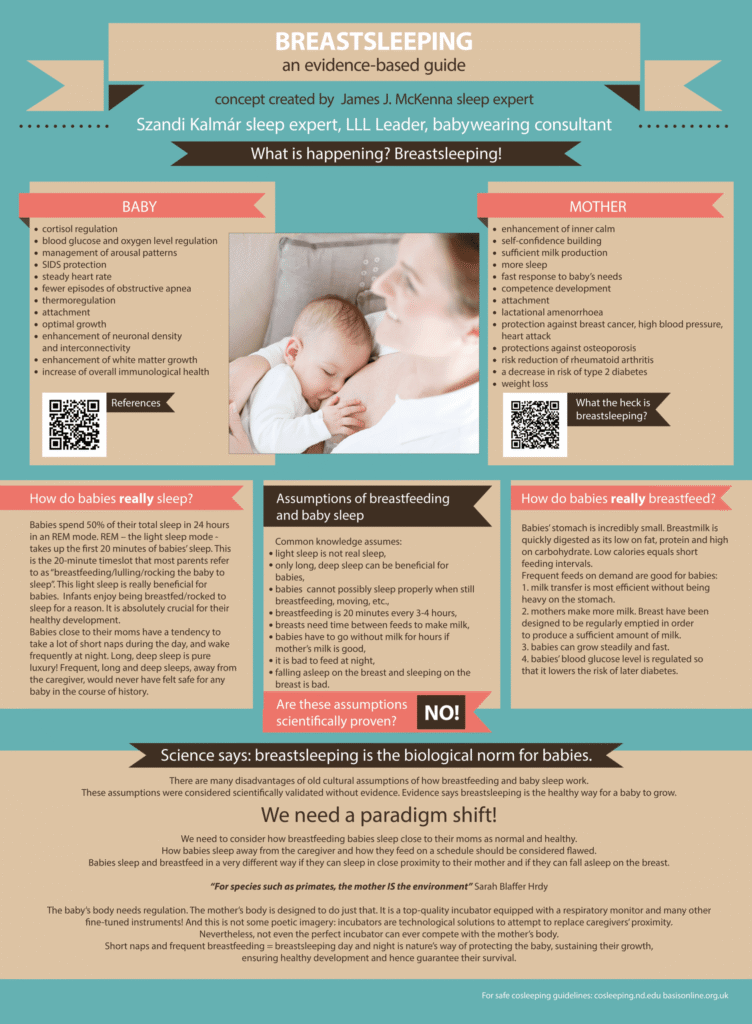
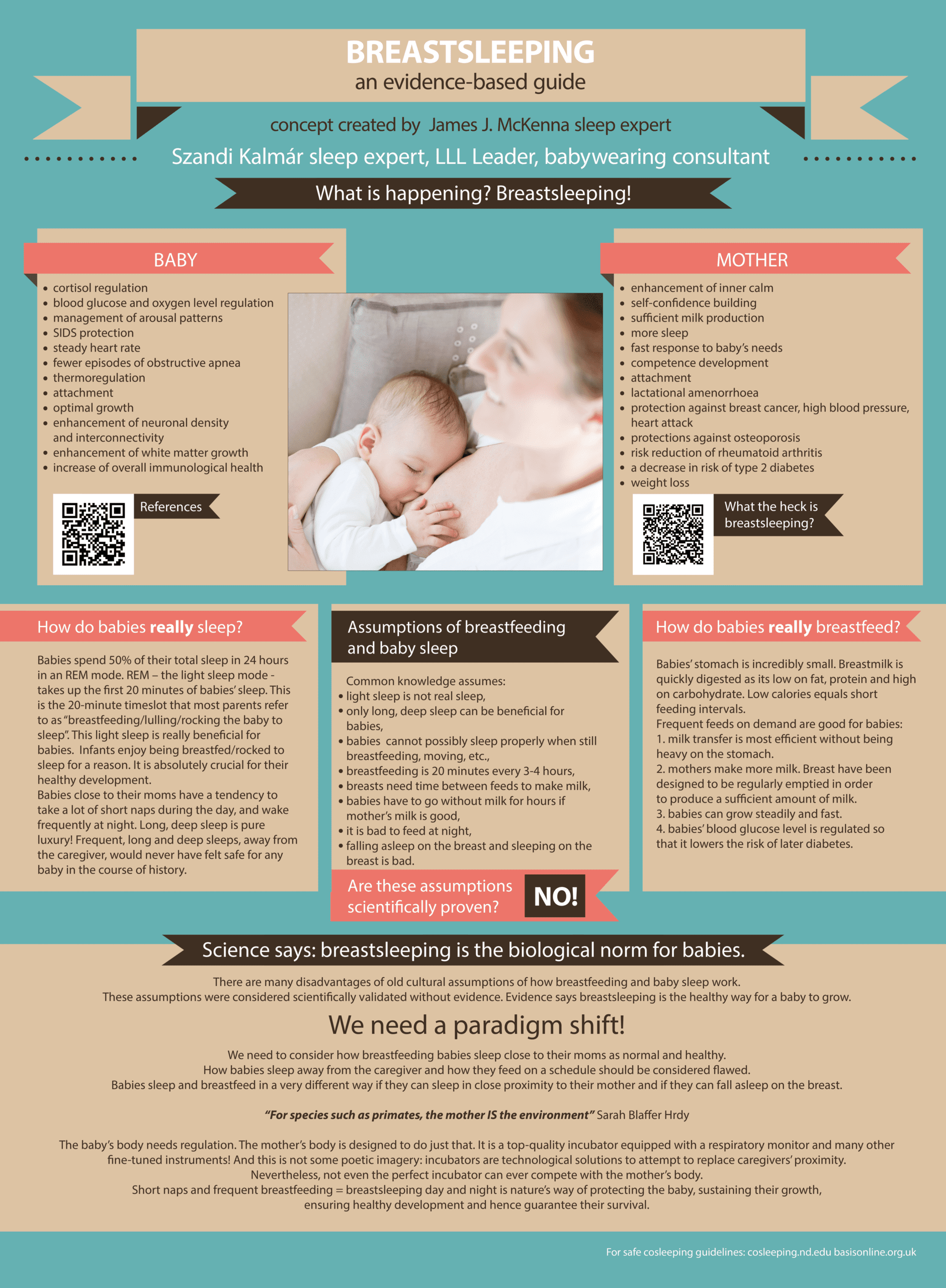
This is the original poster I presented in Paris in 2019. I have kept it in its original form as part of the history of my work.
My understanding has continued to develop since then, and today I would phrase some of its statements with more nuance. Research evolves, and so should the way we communicate it. The central message, however, remains deeply important to me:
Babies are not failing at sleep when they need feeding, closeness and help to settle.
What might this mean for you tonight?
It may simply mean that when your baby wakes as you put them down, you can take one painful thought off your shoulders:
I have not caused this.
You can still want change. You can still experiment with a cot, accept help from someone else, look at your baby’s daytime rhythm or find another way to make the nights more manageable. But you do not have to begin from the belief that your baby is doing something wrong.
Begin with the baby you actually have, the family you actually live in and the amount of energy you actually have left. That is usually where useful change begins.
Further reading
- There is no such thing as infant sleep, there is no such thing as breastfeeding, there is only breastsleeping – Professor James J. McKenna and Lee T. Gettler
- Baby Sleep Information Source – Durham Infancy & Sleep Centre
- Safer sleep advice – The Lullaby Trust
- More baby sleep resources
The information on this page is intended for education and support. It does not replace individual medical advice. If you are concerned about your baby’s feeding, breathing, growth, development or health, please contact an appropriate healthcare professional.
Would you like to explore the research behind breastsleeping?
Read more about the concept and view my original 2019 Paris conference poster.