
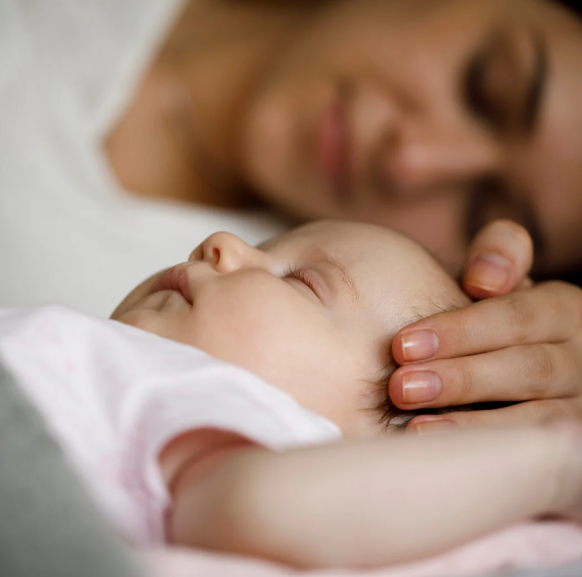
Few baby sleep topics become polarised as quickly as bedsharing.
You may have been told that you should never bring your baby into your bed, under any circumstances. Or you may have heard the opposite: that sleeping beside your baby is biologically normal and therefore perfectly safe.
Neither statement gives you the whole picture.
Bedsharing is common, the circumstances in which families bedshare vary enormously, and the risk is not the same in every situation. That is exactly why I think we need to talk about it properly.
Not because every family should bedshare. And not because every family should avoid it. Because parents deserve enough information to make sleep as safe as possible in the circumstances they actually live in.
First: what do we mean by bedsharing?
Bedsharing means a baby and an adult sleeping on the same sleep surface, usually an adult bed. That is different from room-sharing, where your baby sleeps on a separate surface such as a cot or bedside crib in the same room. Current safer-sleep recommendations generally consider a separate, firm, flat sleep surface in the parents’ room the safest option during infancy.
It is also very different from accidentally falling asleep with a baby on a sofa or armchair.
That distinction matters enormously. When people discuss the risks of “co-sleeping”, several very different sleeping situations can become mixed together. A planned bedsharing arrangement is not equivalent to falling asleep holding your baby on a sofa.
The safest place and the real world are both important
If we were discussing only the lowest-risk sleep environment, the advice would be straightforward: place your baby on their back, on a firm, flat, separate sleep surface, in the same room as you, with the sleep space kept clear. I think parents should know that. But I also think they need information about what to do if their baby ends up in their bed.
Many babies wake frequently at night. Many are breastfed in bed. Many parents become profoundly tired. Some families deliberately bedshare, while others are absolutely certain that they will not — until they wake at three in the morning and realise they have fallen asleep while feeding.
Pretending bedsharing never happens does not make those nights safer.
That is why harm-reduction information matters alongside the safest-sleep recommendation.
Are some bedsharing situations much more dangerous than others?
Yes. This is one of the clearest messages from the research. The risk associated with bedsharing changes substantially depending on the circumstances.
Smoking is particularly important. Bedsharing with a baby when either parent smokes is associated with a substantially increased risk of SIDS, even if smoking does not happen in the bedroom.
Alcohol and drugs or medications that impair alertness also make bedsharing unsafe because they can reduce your ability to wake or respond normally.
Prematurity and low birth weight are additional important risk factors.
And the surface matters. A soft mattress, gaps where a baby could become trapped, pillows and heavy bedding around the baby all introduce hazards that are not present on a clear, firm infant sleep surface.
So asking simply, Is bedsharing safe?, loses crucial information. With whom? On what surface? Under what circumstances? Those questions matter.
Sofas and armchairs are particularly dangerous
This deserves its own section because exhausted parents often try very hard to follow the instruction not to bedshare and inadvertently end up somewhere less safe. You are feeding your baby at night and worried that you might fall asleep. So rather than getting into bed, you sit on the sofa or in an armchair.
Then you fall asleep anyway. Sleeping with a baby on a sofa or armchair is associated with a particularly high risk of death. A baby can become trapped between your body and the cushions or against the side of the furniture, and the surface is not designed for infant sleep.
If there is a realistic chance that you will fall asleep while feeding your baby, avoiding the bed at all costs can sometimes move you into a more hazardous situation. This does not make an adult bed automatically safe. It means accidental sleep needs to be part of safer-sleep planning.
What if I feed my baby in bed?
Night feeds are one of the most common situations in which unplanned bedsharing happens. If you bring your baby into bed to breastfeed or comfort them, the safest option is to return them to their own sleep space before you go back to sleep.
But if you think you may fall asleep during the feed, it makes sense to think about the environment before you are exhausted at two in the morning. Remove pillows and heavy bedding from around the baby. Make sure there are no gaps where they could become trapped. Keep other children and pets away from the baby’s sleep area, and never leave a baby alone in an adult bed.
If you wake after accidentally falling asleep, return your baby to their own sleep space when you can. Planning for something does not mean you are intending it to happen. It means you are acknowledging that tired human beings sometimes fall asleep.
What about breastfeeding and bedsharing?
Breastfeeding and bedsharing are closely connected in many families.
Anthropologist James McKenna and colleagues introduced the term breastsleeping to describe the interconnected physiology and behaviour of breastfeeding and mother–infant sleep. Research using overnight observations has shown that breastfeeding mothers and babies sleeping together often orient towards one another and interact frequently during the night.
This helps us understand why bedsharing is so common among breastfeeding families. It does not, however, mean that breastfeeding cancels every other risk factor. A breastfeeding baby sleeping beside a non-smoking, unimpaired mother on an appropriately prepared surface is in a very different situation from a baby sharing a sofa with an adult who has consumed alcohol.
Biology matters, but circumstances matter too.
Is bedsharing safe if nobody smokes or drinks?
This is where the research becomes more contested. Case-control studies consistently identify smoking, alcohol, drugs, unsafe surfaces and very young infant age as important factors. But researchers have disagreed about whether bedsharing itself carries additional risk for young babies even when those major hazards are absent.
Some analyses have found an increased risk among very young infants even in lower-risk bedsharing circumstances. Others, using different datasets or analytical approaches, have not found a significant increased risk in the absence of additional hazards.
That disagreement is worth being transparent about. I would not tell you that planned, lower-risk bedsharing has been proven to be as safe as a separate infant sleep surface, because the evidence does not establish that.
But I would not describe every episode of bedsharing as though the circumstances were irrelevant either. This is a situation where absolute statements are easier to remember than nuanced ones, but the nuance is important.
What does “safer bedsharing” actually mean?
If bedsharing happens, there are practical ways to reduce known hazards. Your baby should be full-term and healthy, and nobody sharing the bed should smoke. You should not bedshare after drinking alcohol or taking recreational drugs, sedating medication or anything else that makes you unusually sleepy or less responsive.
The mattress should be firm and flat. Keep pillows, duvets and loose bedding away from your baby, and make sure there are no gaps between the mattress and wall, headboard or furniture where they could become trapped. Your baby should sleep on their back and should not be swaddled while bedsharing. Keep other children and pets out of the baby’s sleep area.
Never bedshare on a sofa or armchair. These precautions do not transform an adult bed into a cot. They reduce identifiable risks when bedsharing occurs.
What about the Safe Sleep Seven?
You may have encountered the Safe Sleep Seven, developed within breastfeeding advocacy as a practical harm-reduction framework for families who bedshare. It brings together several of the factors we have just discussed: a non-smoking parent, sobriety, breastfeeding, a healthy full-term baby, baby on their back, no swaddling, and a safe sleep surface.
It can be a useful way of remembering important precautions, particularly for breastfeeding families. I would still place it in context. It is a harm-reduction framework, not evidence that bedsharing becomes risk-free when seven boxes are ticked. That distinction matters.
What if my baby will only sleep beside me?
Then I would start with the reality you are living in. Perhaps your baby wakes every time you transfer them. Perhaps you are managing frequent breastfeeding throughout the night. Perhaps you had planned never to bedshare and are now so exhausted that you regularly find yourself asleep with your baby anyway.
You still deserve practical help. We can look at whether a bedside cot might work, whether another adult can help, whether some parts of the night can happen on a separate surface, whether settling can gradually become easier, or whether a deliberately prepared bedsharing arrangement would reduce the risks of what is currently happening accidentally.
Your exhaustion belongs in the safety conversation too. That does not mean fatigue makes every sleep arrangement safe. It means advice that ignores how tired you are may fail precisely when you most need it.
Do I have to bedshare to be responsive or attached?
Absolutely not. You can breastfeed responsively, comfort your baby whenever they need you, build a secure relationship and never intentionally share a bed. A bedside cot or ordinary cot in your room may work beautifully for your family. Some babies genuinely sleep well on a separate surface from very early on.
Bedsharing is not a measure of attachment. And the reverse matters too: choosing to bedshare does not mean you are careless about safety. It means you need accurate information about the particular risks involved.
I would rather you plan than promise
Before your baby arrives, it is easy to say, I will never fall asleep with the baby in my bed. At three in the morning after weeks of fragmented sleep, things can look different.
So even if you have absolutely no intention of bedsharing, I think it is worth knowing what makes accidental sleep particularly dangerous. Know that the sofa is not the safer alternative. Know what alcohol, smoking and sedating substances do to the risk. Know what should not be around your baby if you might fall asleep while feeding. And if you deliberately bedshare, learn the same information and prepare the environment carefully.
The safest-sleep recommendation can remain clear while harm-reduction information remains available. We do not have to choose between the two.
The goal is not to persuade you to bedshare or persuade you not to. It is to make sure that whichever way your family sleeps tonight, you have enough information to make it safer.
Research
Blair PS, Sidebotham P, Evason-Coombe C, Edmonds M, Heckstall-Smith EMA, Fleming P. (2009). Hazardous cosleeping environments and risk factors amenable to change: case-control study of SIDS in south west England. BMJ, 339, b3666.
Carpenter R, McGarvey C, Mitchell EA, et al. (2013). Bed sharing when parents do not smoke: is there a risk of SIDS? An individual level analysis of five major case-control studies. BMJ Open, 3, e002299.
Blair PS, Sidebotham P, Pease A, Fleming PJ. (2014). Bed-sharing in the absence of hazardous circumstances: is there a risk of sudden infant death syndrome? PLOS ONE, 9(9), e107799.
McKenna JJ, Gettler LT. (2016). There is no such thing as infant sleep, there is no such thing as breastfeeding, there is only breastsleeping. Acta Paediatrica, 105(1), 17–21.