
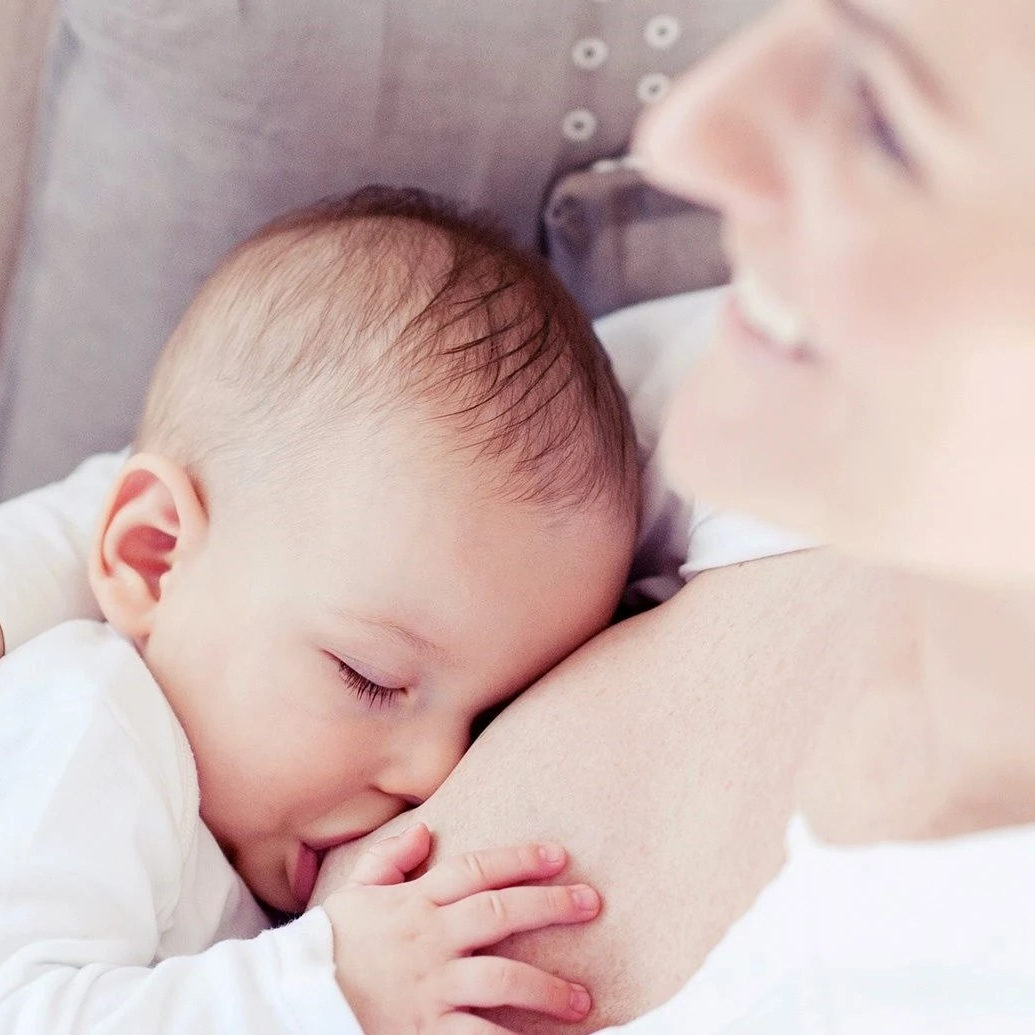
Breastsleeping:
What It Means and How Breastfed Babies Really Sleep
Breastfeeding and infant sleep are often discussed as though they were two separate subjects. We talk about how often a baby feeds, and then we talk about where, when and how long they sleep.
But for a breastfeeding baby, feeding and sleeping are closely intertwined.
Babies may feed while becoming drowsy, fall asleep at the breast, stir and feed without fully waking, or move repeatedly between feeding, light sleep and deeper sleep. Once we look at what babies actually do, separating breastfeeding from sleep begins to make much less sense.
This is the idea behind breastsleeping.
This page also tells the story of my breastsleeping poster, presented at the 11th Journée Internationale de l’Allaitement in Paris in 2019. The accompanying French edition has since been downloaded more than 12,000 times from La Leche League France.
What does breastsleeping mean?
The term breastsleeping was introduced by Professor James J. McKenna and anthropologist Lee T. Gettler to describe the interconnected physiology and behaviour of breastfeeding and mother–infant sleep.
More specifically, their original definition refers to a breastfeeding mother and baby sharing the same sleep surface in the absence of known hazardous factors.
This distinction matters. Breastsleeping is not simply another word for every form of bedsharing, and it does not mean that every shared sleeping arrangement carries the same level of risk.
The concept draws attention to something baby-sleep advice has often overlooked: breastfeeding does not stop when the lights go out, and sleep does not take place independently of feeding, proximity and regulation.
How do breastfed babies really sleep?
Young babies do not usually move through the night like adults. Their sleep cycles are shorter, their sleep contains more active sleep, and waking to feed remains common throughout infancy.
Some babies sleep for longer stretches quite early. Others wake frequently. Many move between shorter and longer stretches, sometimes changing from one week to the next.
Feeding to sleep is also biologically unsurprising. Sucking, milk, warmth, touch and proximity all help babies settle. A baby falling asleep at the breast is not failing to develop a skill. They are using one of the most effective forms of regulation available to them.
Night feeding also contributes to milk intake and milk production, particularly during the early months. For some babies, a substantial part of their total milk intake continues to happen at night.
None of this means that every breastfeeding family must sleep in the same way. It means that frequent waking, feeding and seeking closeness should not automatically be treated as evidence that something has gone wrong.
Why did we need a new word?
For many years, infant sleep research and breastfeeding research were often treated as separate fields.
A study might examine how often a baby woke without looking closely at feeding. Another might examine breastfeeding frequency without considering where the baby slept or how mother and baby interacted during the night.
The word breastsleeping challenges that separation.
It invites us to look at the whole system:
- how mother and baby orient towards one another;
- how feeding and sleep alternate during the night;
- how proximity affects maternal and infant behaviour;
- how cultural expectations shape what parents believe their baby “should” be doing;
- and how the sleeping environment changes both experience and risk.
This does not give us one correct sleeping arrangement for every family. It gives us a more complete way of understanding what we see.
What breastsleeping does not mean
Breastsleeping is sometimes presented as though biology alone makes bedsharing safe. That is not what the evidence allows us to say.
Breastfeeding does not cancel the risks associated with smoking, alcohol, sedating medication, recreational drugs, unsafe surfaces, pillows, heavy bedding, gaps, sofas or armchairs. Prematurity, low birth weight and a baby’s age also matter.
A separate, firm, flat and clear infant sleep surface in the parents’ room remains the lowest-risk arrangement during infancy.
At the same time, many parents bring their babies into bed to feed, and some will fall asleep whether they intended to or not. Families therefore need both a clear safest-sleep recommendation and practical information about reducing identifiable hazards.
I explore this in much more detail here:
Read: Bedsharing With a Baby – What Does the Evidence Actually Say?
Does your baby wake as soon as you put them down?
If your baby sleeps peacefully beside you but wakes in their cot, feeds to sleep or only takes short naps in your arms, this article is for you.
Read: Why Does My Baby Sleep Better Beside Me?
The story behind this poster
I originally developed this material in Hungarian to help parents understand the relationship between breastfeeding, proximity and infant sleep.
In November 2019, I presented the English poster at the 11th Journée Internationale de l’Allaitement, organised by La Leche League France at the Cité des Sciences et de l’Industrie in Paris.
The original Hungarian article was later translated into French by Stéphanie Bonef and published by La Leche League France under the title:
Le dorm’allaitement, ou comment dorment les bébés
The French page includes the translated article and a downloadable French edition of the poster. By September 2026, the poster had been downloaded more than 12,000 times.
The original 2019 English conference poster
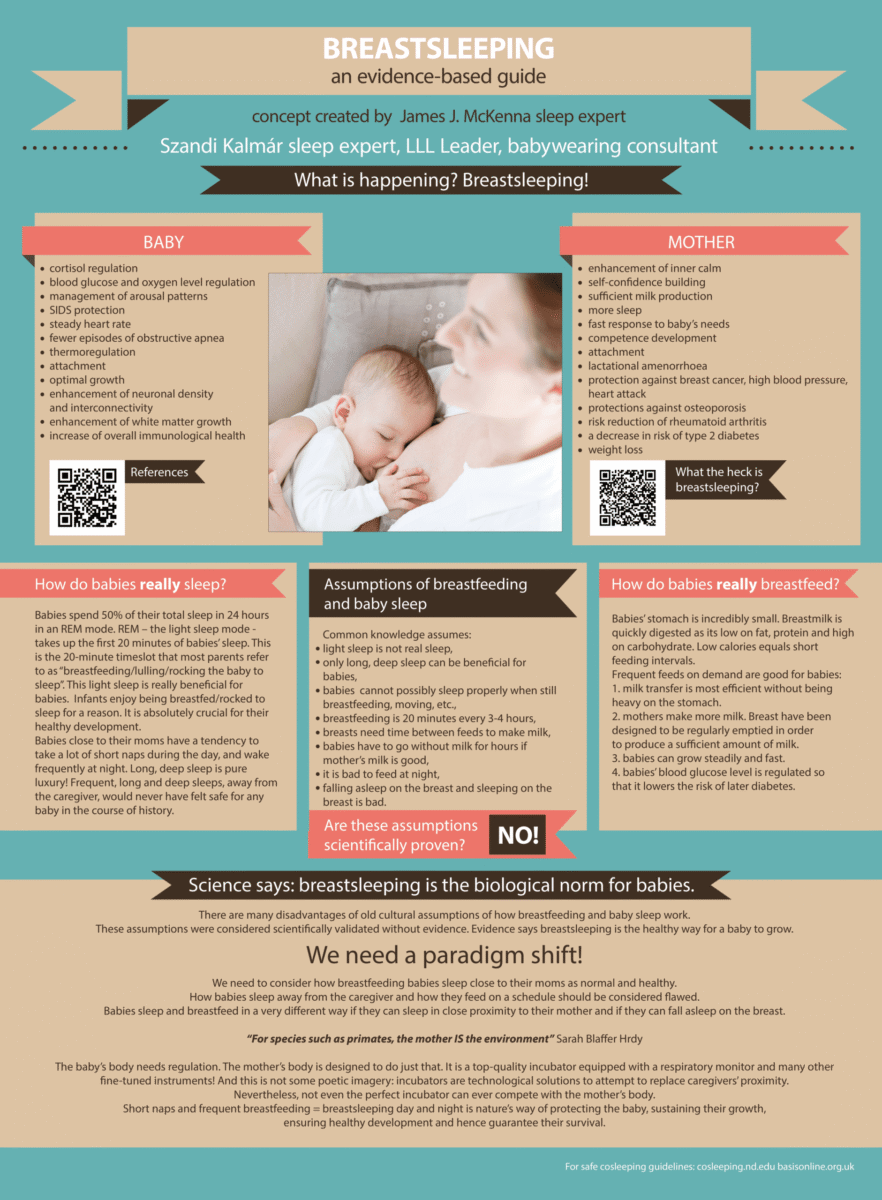
Breastsleeping: An Evidence-Based Guide, presented by Alexandra Kalmár at the 11th Journée Internationale de l’Allaitement, Paris, 2019.
A note about the original poster
This is the original conference poster and is preserved here as part of my professional work and the history of this resource.
Research and the way I communicate evidence have continued to develop since 2019. Today, I would qualify some of its statements more carefully, distinguish more clearly between the benefits associated with breastfeeding and the specific evidence concerning breastsleeping, and give safer-sleep context greater prominence.
I have left the original poster unchanged because it represents the work as it was presented at the conference. The article you are reading provides the updated context I would now place around it.
What has stayed with me since 2019
The central idea remains important: we cannot fully understand a breastfeeding baby’s sleep if we remove feeding, proximity and the relationship with their caregiver from the picture.
But understanding biology does not require us to prescribe one sleeping arrangement.
Some families breastfeed and bedshare. Some use a bedside cot. Some return their baby to a separate cot after each feed. Some combine several arrangements across the same night. These choices may also change as the baby grows or the family’s circumstances change.
The useful question is not:
What should every baby do?
It is:
What is happening for this baby and this family, and how can we make their real situation safer and more manageable?
Further reading
- Bedsharing With a Baby: What Does the Evidence Actually Say?
- The Baby Sleep Handbook
- Baby Sleep Resources
- The French article and poster on La Leche League France
References
McKenna, J. J., & Gettler, L. T. (2016). There is no such thing as infant sleep, there is no such thing as breastfeeding, there is only breastsleeping. Acta Paediatrica, 105(1), 17–21. https://doi.org/10.1111/apa.13161
McKenna, J. J., Ball, H. L., & Gettler, L. T. (2007). Mother–infant cosleeping, breastfeeding and sudden infant death syndrome: What biological anthropology has discovered about normal infant sleep and pediatric sleep medicine. American Journal of Physical Anthropology, Supplement 45, 133–161. https://doi.org/10.1002/ajpa.20736
Blair, P. S., Sidebotham, P., Pease, A., & Fleming, P. J. (2014). Bed-sharing in the absence of hazardous circumstances: Is there a risk of sudden infant death syndrome? PLOS ONE, 9(9), e107799. https://doi.org/10.1371/journal.pone.0107799
For current practical safer-sleep information, see BASIS – the Baby Sleep Information Source and The Lullaby Trust.
The information on this website is for educational purposes only and is not a substitute for individual medical advice, diagnosis or treatment. Always seek appropriate professional advice if you have concerns about your baby’s health, development or safety.