
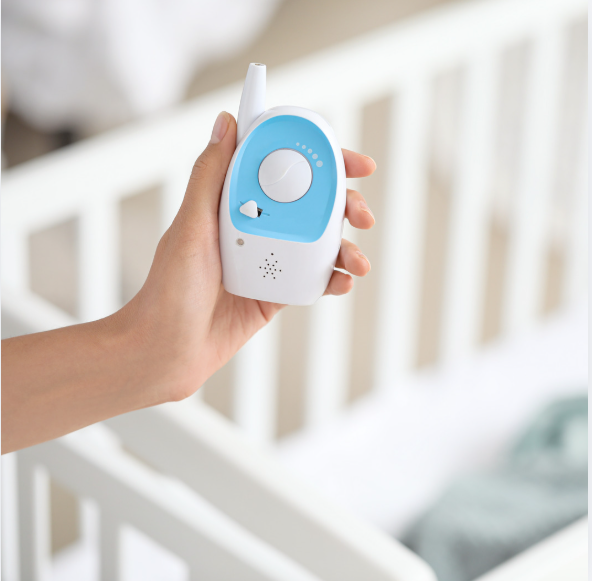
White noise has become one of those baby sleep tools that can sound either essential or terrifying, depending on what you happen to read first. One person tells you that your baby needs it because the womb was noisy. Another warns that you could damage your baby’s hearing or interfere with brain development. Meanwhile, your baby may simply be sleeping beautifully beside a little machine making a noise remarkably similar to an extractor fan.
So what do we actually know?
White noise can help some babies settle or stay asleep, but it is not necessary for healthy sleep and it is not completely risk-free if used too loudly or too close to your baby. The most useful question is not whether white noise is universally good or bad. It is whether it helps your baby, and if it does, how to use it sensibly.
What is white noise?
Technically, white noise contains sound energy across a broad range of frequencies. Many products marketed as white-noise machines do not produce true white noise at all. They may play pink noise, brown noise, rainfall, waves, fans or other continuous sounds.
From a practical baby-sleep perspective, the important feature is usually that the sound is steady and relatively uninteresting.
A continuous background sound can partly mask sudden environmental noises: somebody closing a door, a dog barking outside, an older sibling dropping something in the next room or the neighbours choosing naptime to begin drilling into a wall.
That masking effect is one plausible reason some babies seem to sleep better with it.
Does white noise actually help babies sleep?
There is some evidence that it can, but much less than the confidence of the internet might suggest.
One small, older randomised study found that newborns exposed to white noise were more likely to fall asleep within five minutes than those who were not. That is interesting, but it was a small study and certainly not enough to conclude that all babies should sleep with white noise.
More recent research on sound and infant sleep is still limited and varies considerably in what kind of sound is used, how loudly it is played and what outcome researchers measure.
So I would describe white noise as a potentially useful sleep aid, not an evidence-based requirement for baby sleep.
If your baby does not use it and sleeps perfectly well, there is no reason to introduce it because you have read that babies “need” background noise.
But wasn’t the womb noisy?
Yes, the developing baby is exposed to sound before birth. Maternal cardiovascular activity, breathing, digestive sounds and sounds transmitted from outside the body all contribute to the prenatal auditory environment.
But this does not mean that a newborn therefore requires artificial white noise for healthy sleep.
The womb is also dark, warm and rather difficult to reproduce in your bedroom. We do not need to recreate every feature of prenatal life after birth.
The comparison may help explain why some newborns find continuous sound soothing, but “the womb is noisy” is not evidence that a white-noise machine needs to run beside your baby all night.
Can white noise damage a baby’s hearing?
This is where the discussion becomes much more important.
In a frequently cited study, researchers tested fourteen infant sleep machines at different distances and found that all of them were capable of producing sound levels above 50 dBA when measured close to the device, and several could produce potentially hazardous levels at maximum volume.
That study did not show that babies using white-noise machines had hearing damage. It tested what the machines were capable of producing.
The distinction matters. A machine that can be played dangerously loudly is not automatically dangerous when used at a sensible volume and distance.
But it does give us a very good reason not to put a white-noise machine next to your baby’s head and turn it up to maximum volume.
How loud should white noise be?
You will often see 50 dBA presented online as though it were a scientifically established universal maximum for infant white noise.
The reality is a little more complicated.
The 50 dBA figure is often derived from recommendations for environmental noise in hospital nurseries rather than from research identifying a precise safe threshold for white noise during infant sleep at home. We do not have strong evidence showing that 49 dBA is safe while 51 dBA suddenly becomes harmful.
That does not mean volume does not matter. It means I would rather explain the uncertainty than give you a beautifully precise number that the research cannot really support.
As a practical precaution, keep the sound comfortably low and place the device well away from your baby’s head. There is no advantage in making it louder than necessary to mask the noises you are trying to soften.
If you have to raise your voice significantly to speak over it beside your baby, I would turn it down.
Distance matters too
Sound intensity decreases as you move away from the source, so where you put the machine matters as well as the volume setting.
I would not attach a white-noise device to the cot, place a phone playing white noise beside your baby’s head or put a speaker directly next to the sleep space.
Put it further away in the room and use the lowest volume that does what you need it to do.
White noise should be background sound, not the main event.
Does it need to stay on all night?
Not necessarily.
Some families use it only while the baby is falling asleep. Others leave it running because it helps mask household or street noise throughout the night.
There is no good evidence that every baby who falls asleep with white noise needs it continuously until morning.
If your baby sleeps happily after it switches off, let it switch off. If sudden environmental sounds repeatedly wake them once it stops, leaving a quiet continuous sound running may be useful.
Again, I would let the actual problem guide the solution.
Will my baby become dependent on white noise?
I would be careful with the word dependent.
If your baby becomes accustomed to falling asleep with a particular sound, they may notice when that sound is absent. Adults do exactly the same thing. Some of us sleep better with a fan, an open window, complete silence or the familiar noises of our own home.
That is not necessarily a harmful dependency.
And white noise has one practical advantage over many other sleep aids: it is remarkably portable. A sound machine can travel to Grandma’s house or a hotel considerably more easily than your baby’s bedroom.
If it works and you do not mind using it, I would not create a problem simply because your baby has developed a familiar sleep cue.
Do I need to wean my baby off white noise?
No, not simply because they reach a particular age.
If you decide you no longer want to use it, you can gradually reduce the volume over several nights or simply try turning it off and see what happens.
You may discover that nothing happens at all.
This is something I see with many sleep supports. Parents worry in advance about how they will eventually remove them, but babies and children are changing all the time. Something that feels essential at four months may quietly become irrelevant later without requiring a formal programme to eliminate it.
If your toddler suddenly tells you to turn the noise off, congratulations. The weaning plan has been completed for you.
What about pink noise or brown noise?
These sounds differ in how sound energy is distributed across frequencies. Pink noise contains relatively more energy at lower frequencies than white noise, while brown noise is weighted even more heavily towards lower frequencies. Subjectively, many people find them softer or deeper than true white noise.
There is interesting research in adults on particular types of sound and sleep, but we do not have good evidence that babies need pink noise rather than white noise, or that one colour of noise produces superior infant sleep.
Choose a steady sound that is not irritating, keep it at a sensible volume and do not worry that you have selected the wrong colour.
Your baby is unlikely to know.
What about music, lullabies and nature sounds?
These are slightly different because they contain changing patterns rather than a continuous broadband sound.
That does not make them bad. A familiar lullaby can become a lovely part of a bedtime routine, and some babies settle beautifully to quiet music.
But if your purpose is specifically to mask unpredictable household noise, a steady background sound is likely to do that more consistently than a track that becomes very quiet, changes suddenly or stops between songs.
I would also avoid leaving devices with bright screens or changing lights near the sleep space simply because they happen to include a white-noise function. You do not need to turn a simple background sound into a miniature entertainment system.
Could white noise affect brain development?
You may come across alarming claims that continuous white noise interferes with auditory development.
Some of these concerns come from animal research showing that prolonged exposure to particular patterns of continuous noise can alter auditory cortical development. That research is worth knowing about, but it cannot simply be translated into the claim that ordinary, low-level white noise used during human infant sleep damages the brain.
At present, we do not have evidence showing that appropriately used white noise causes neurodevelopmental harm in babies. We also do not have enough long-term research to say that every pattern of continuous sound exposure is irrelevant.
That is another reason I prefer sensible use over extremes. You do not need loud white noise running twenty-four hours a day. Your baby should spend their waking life hearing ordinary human voices, music, environmental sounds, silence and the enormous variety of sound that comes with being part of everyday life.
If white noise works, you can use it
I would not introduce white noise because somebody has told you that babies cannot sleep without it. I would not remove it from a family whose baby sleeps well with it simply because somebody else has labelled it a bad sleep association.
If you use it, keep the machine away from your baby’s head, keep the volume comfortably low and remember that louder is not better.
Then look at your baby and your family.
Perhaps white noise makes no difference whatsoever. Turn it off and reclaim the plug socket.
Perhaps it masks the older children’s morning chaos and buys your baby another half-hour nap. That sounds useful.
Or perhaps it has simply become one familiar part of sleep — alongside the sleeping bag, the cuddle, the feed, the darkened room and the person your baby trusts.
It does not need to be more complicated than that.
Research
Spencer JAD, Moran DJ, Lee A, Talbert D. (1990). White noise and sleep induction. Archives of Disease in Childhood, 65(1), 135–137.
Hugh SC, Wolter NE, Propst EJ, et al. (2014). Infant sleep machines and hazardous sound pressure levels. Pediatrics, 133(4), 677–681.
Kujawa SG, Liberman MC. (2009). Adding insult to injury: cochlear nerve degeneration after “temporary” noise-induced hearing loss. Journal of Neuroscience, 29(45), 14077–14085.