
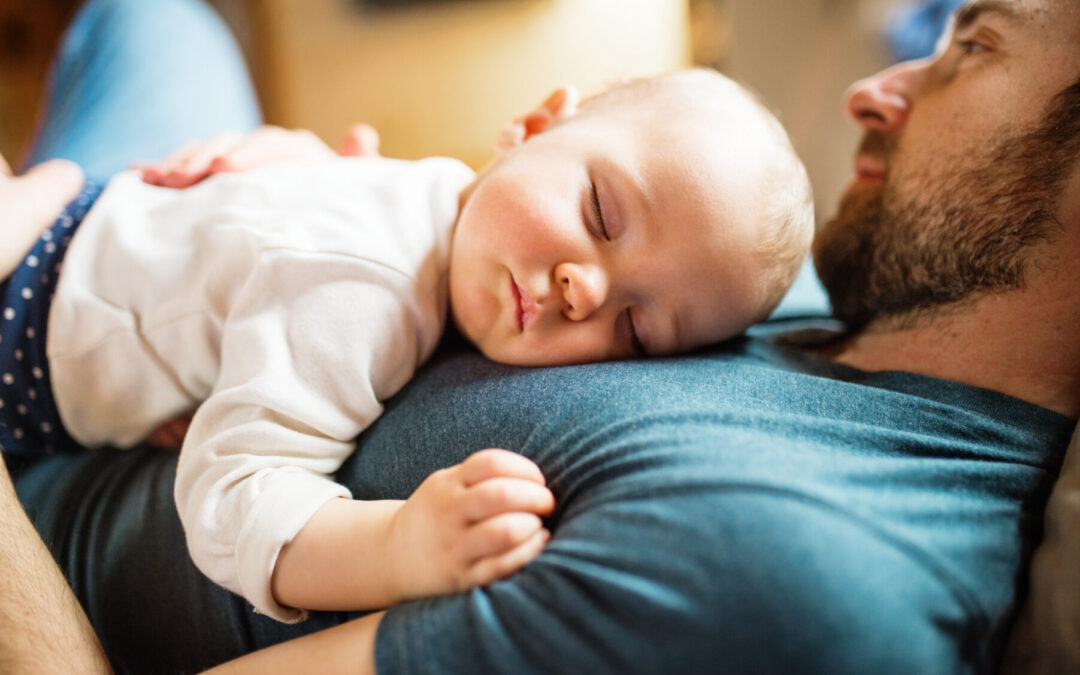
Your baby sleeps beautifully on you and wakes three minutes after you put them down. Is this something you need to change — or simply something babies often do?
There is a particular kind of optimism involved in transferring a sleeping baby. You wait until they look completely gone. The arm is floppy. The breathing has changed. Surely this is it. You stand up slowly, walk towards the cot, lower them with the concentration of someone defusing a bomb, keep one hand on their chest for a little longer, then begin removing your fingers one by one.
Eyes open. If your baby will happily sleep for an hour and a half on your chest but manages seven minutes in the cot, you are in very good company.
Contact naps are incredibly common, especially with young babies. They can also become one of those things parents start worrying about surprisingly quickly. Is my baby getting too used to sleeping on me? Should I be practising cot naps? Am I creating a bad habit? And the particularly alarming version: if I don’t stop this now, will they ever sleep without me?
Before we start trying to fix anything, I think it is worth asking why sleeping on another human might be so attractive to a baby in the first place.
Why does my baby sleep so much better on me?
From your baby’s point of view, your body is quite an impressive sleep environment. There is warmth, smell, breathing, touch and often movement. If you are breastfeeding, there may also have been sucking and milk immediately before sleep. Then we compare all of that with a firm, flat, still mattress and wonder why the mattress isn’t winning.
Young babies are extraordinarily dependent on other people. Physical contact is part of early regulation, and research on skin-to-skin contact and parent–infant proximity has documented effects on newborn physiology and breastfeeding. There is also experimental work suggesting that maternal proximity during sleep can affect physiological calming in young infants.
I would be careful not to stretch this evidence into therefore every baby biologically needs to contact nap. It doesn’t show that. Babies vary enormously, and some will sleep perfectly happily away from a parent’s body from very early on.
What it does mean is that we don’t need to treat a young baby’s preference for warmth, movement and another body as some mysterious malfunction that you accidentally created by cuddling them too much. Some babies tolerate being put down relatively easily. Others appear genuinely astonished that you would even suggest it.
I loved contact naps. Until I didn’t.
I have a photograph of myself teaching while my younger daughter, then three months old, is asleep against me in a woven wrap. I still love that photograph because it captures what babywearing gave me at the time: freedom. My baby didn’t have to be removed from family life in order to sleep, and I didn’t have to stop everything every time she needed a nap. I could feed her, settle her, carry her and get on with quite a lot of ordinary life while she slept against me.
For me, that worked.
But this is exactly where I don’t want to turn my experience into another rule for somebody else. Perhaps you love having your baby asleep on your chest. Perhaps this is the one part of the day when you finally sit down, make a cup of tea and watch something ridiculous on Netflix with a warm sleeping baby on you. Or perhaps you have been underneath that baby for every nap for five months and you would quite like to eat lunch using both hands. Both are allowed.
Being told “contact naps are biologically normal” is not especially helpful when what you are actually trying to say is “Yes, but I desperately need a shower.”
Does contact napping create a bad habit?
Not simply by existing. Your baby can certainly become familiar with sleeping on you, just as they can become familiar with feeding, rocking, a pram, a carrier, a particular song or sleeping in their cot. We talked about this in the sleep associations article: babies learn associations, but the existence of an association does not automatically make it a problem.
The more useful question is whether the arrangement is still working.
At three months, for example, I would not look at a baby who still takes every nap on a parent and conclude that somebody has missed the window for independent sleep. Some babies are beginning to sleep away from the body much more easily by then; others still wake almost instantly when transferred.
And this changes. A lot. A baby who will only sleep in a carrier at eight weeks may happily sleep in a pram later. A baby who takes long contact naps with you may take completely different naps at nursery. They may breastfeed to sleep with you and be rocked by your partner or carried by a grandparent. Babies are quite capable of learning that sleep happens differently with different people and in different places.
You do not have to make every sleep look the same in the name of consistency.
But shouldn’t I practise cot naps?
You can, if you want to. This is where I would keep the whole thing much more relaxed than most sleep programmes do. If you would like your baby to sleep away from you sometimes, try putting them down. Perhaps transfer them once they are deeply asleep. Perhaps stay beside them for a while. Perhaps try the first nap of the day because that happens to be the easiest one for your baby. Perhaps your partner discovers a completely different method that inexplicably works for them and never works for you.
If the experiment works, excellent. You have another option. If your baby wakes immediately, you have not failed today’s cot-nap lesson. You have simply discovered that it didn’t work today. You can try again another time. I don’t think you need to spend every nap repeatedly putting down an increasingly angry baby because somebody has convinced you that independent sleep needs to be practised before a developmental door slams shut.
There is no evidence for such a deadline.
What if I genuinely cannot do contact naps anymore?
Then I want to hear that too. One of the things I care about in my work is that understanding a baby’s needs should not make the parent disappear from the picture. You can understand perfectly well why your baby wants your body and still desperately want twenty minutes without somebody touching you. You can love your baby enormously and be completely fed up with being a mattress. You may have another child who needs lunch, a job to do, a back that hurts, or simply a need to move around your own house.
“My baby wants me” and “I need a break” can both be true.
If you want to change contact naps, I would start there rather than with fear about independence. What would actually make your day easier? Do you need one nap off your body rather than all of them? Could somebody else take one? Would a pram work? Could your baby sleep in a carrier with another trusted adult? Do you want to experiment with transferring them after they fall asleep? Sometimes making one nap different is enough to make the whole day feel manageable again. And sometimes the answer is a carrier.
The carrier can be a lifesaver — but sleep still needs to be safe
Babywearing was enormously useful to me, and for some families it turns the contact-nap problem into much less of a problem because the baby gets closeness while the adult gets their hands back. There is even a classic randomised study in which babies assigned to increased carrying cried and fussed considerably less, with the biggest difference around the six-week peak in crying. Interestingly, they didn’t sleep more. Carrying seemed to affect crying and contentment rather than simply producing extra sleep.
But a sleeping baby in a carrier still needs a safe position. The carrier should fit properly, the baby’s face needs to remain visible, their airway unobstructed, their chin off their chest and their back appropriately supported. Very young, premature or medically vulnerable babies may need individual advice.
And if you are having a contact nap with your baby lying on you, there is another distinction that matters enormously: you need to stay awake. Accidentally falling asleep with a baby on a sofa or armchair is not a safe contact nap. If you think there is a real chance you may fall asleep too, that becomes a safer-sleep conversation rather than simply a discussion about nap habits.
Will my baby ever nap without me?
Almost certainly their sleep will change. I just can’t give you a date. That is the irritating part of babies. There is no Tuesday morning when the contact-nap phase officially ends. Your thirteen-week-old may still want almost constant contact while somebody else’s baby is perfectly happy lying alone. Over the following months, movement, curiosity and the ability to explore the world expand enormously, and sleep changes alongside everything else.
You don’t have to push your baby away from you to make development happen. And you don’t have to wait passively for development either if the current situation is exhausting you.
Use contact naps when they help. Experiment with other ways of sleeping when you want more options. Let somebody else become part of your baby’s sleep world if you have somebody available. Change things because your family needs something different, not because your three-month-old has failed to demonstrate sufficient independence.
If your baby sleeps happily on you and you are both enjoying it, I don’t see a problem that needs solving. If you are reading this trapped under a sleeping baby while desperately needing the toilet, however, I completely understand why you might want another option.
Research behind this article
Esposito G, Yoshida S, Ohnishi R, et al. (2013). Infant calming responses during maternal carrying in humans and mice. Current Biology, 23(9), 739–745. Experimental work examining the calming effects of maternal carrying on young infants.
Hunziker UA, Barr RG. (1986). Increased carrying reduces infant crying: a randomized controlled trial. Pediatrics, 77(5), 641–648. Infants assigned to supplementary carrying cried and fussed less, particularly around the usual six-week crying peak; increased carrying did not simply increase sleep.
Morgan BE, Horn AR, Bergman NJ. (2020). Experimental manipulation of maternal proximity during short sequences of sleep and infant calming response. Infant Behavior and Development, 59, 101426. A small experimental study of 24 young infants found differences in physiological calming according to maternal proximity during a nap session.